
Why chlorine is used
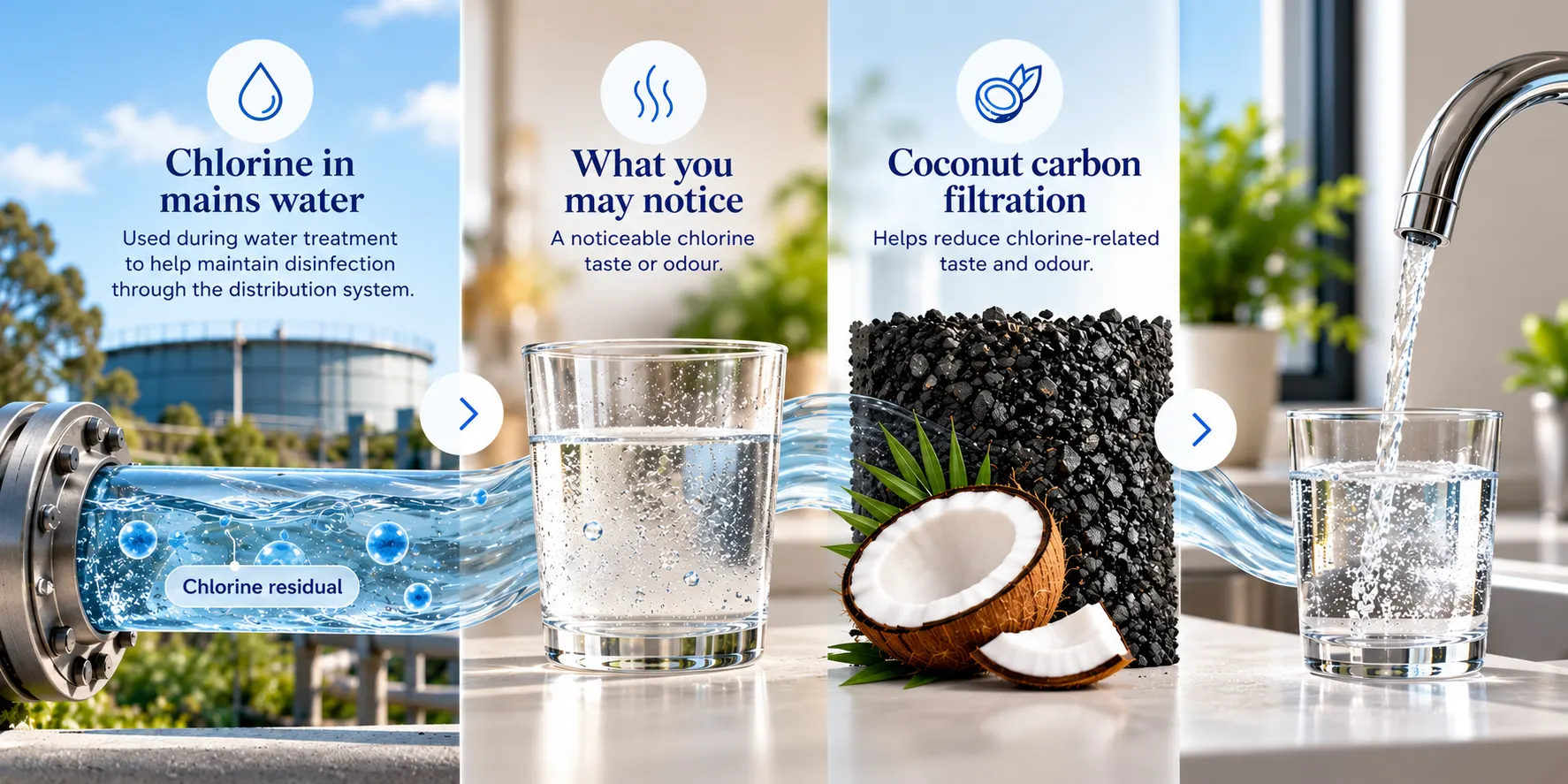
Chlorine is one of the most established drinking-water disinfectants. It inactivates microorganisms and, importantly for a reticulated water network, can leave a residual that continues to protect water as it moves through reservoirs and pipes.
Water Corporation states that it adds chlorine to its water supply schemes for disinfection and ongoing protection through the network. Aqwest and Busselton Water also describe chlorination as part of their drinking-water treatment processes.
Safety and taste are separate questions
The Australian Drinking Water Guidelines distinguish health-based and aesthetic guideline values. For total chlorine, the health-based guideline value is 5 mg/L. The Guidelines also note that chlorine has an odour threshold around 0.6 mg/L, with some people able to notice lower concentrations.
This is why a person can notice a chlorine taste or smell even when the water remains within health-based drinking-water guidance.
What carbon filtration does
Activated carbon is widely used to reduce chlorine and associated taste or odour. Its performance depends on the carbon media, contact time, flow, water chemistry and cartridge condition.
Purenest Australia’s supplied whole-home performance data recorded an average 93.75% reduction in free available chlorine over a reported 100,000 L test capacity under the stated test conditions of approximately 15.3 L/min and approximately 410 kPa. That test result should not be treated as a universal percentage at every household flow.
What chlorine filtration does not prove
- A chlorine result does not automatically prove the same performance for chloramine.
- It does not demonstrate removal of every disinfection by-product or every dissolved contaminant.
- Removing residual disinfectant from household water is a treatment preference; public-water disinfection itself remains an important public-health control.
When homeowners usually ask about chlorine
Common reasons include a noticeable pool-like smell, taste in drinking water, or a preference to reduce residual disinfectant before water reaches multiple household outlets.
If the concern is only drinking water at one tap, a point-of-use carbon or RO system may be sufficient. If the preference is treatment before bathrooms, kitchen and laundry, whole-home filtration is the relevant architecture.
Common questions
Is chlorine in drinking water automatically unsafe?
No. Chlorine is used deliberately as a disinfectant. A household may still prefer to reduce its taste or odour after the water has reached the property.
Is chloramine the same as chlorine?
No. Chloramine is a combined disinfectant formed using chlorine and ammonia. It behaves differently and should be considered separately.
Sources and last reviewed
Last reviewed: September 2026.
- NHMRC — Chlorine fact sheet
- Water Corporation — Drinking water quality
- Aqwest — Water treatment process
- Busselton Water — Water treatment
This article is general educational information and does not replace water testing, utility advice, plumbing advice or health advice for a specific circumstance.