
What hardness means
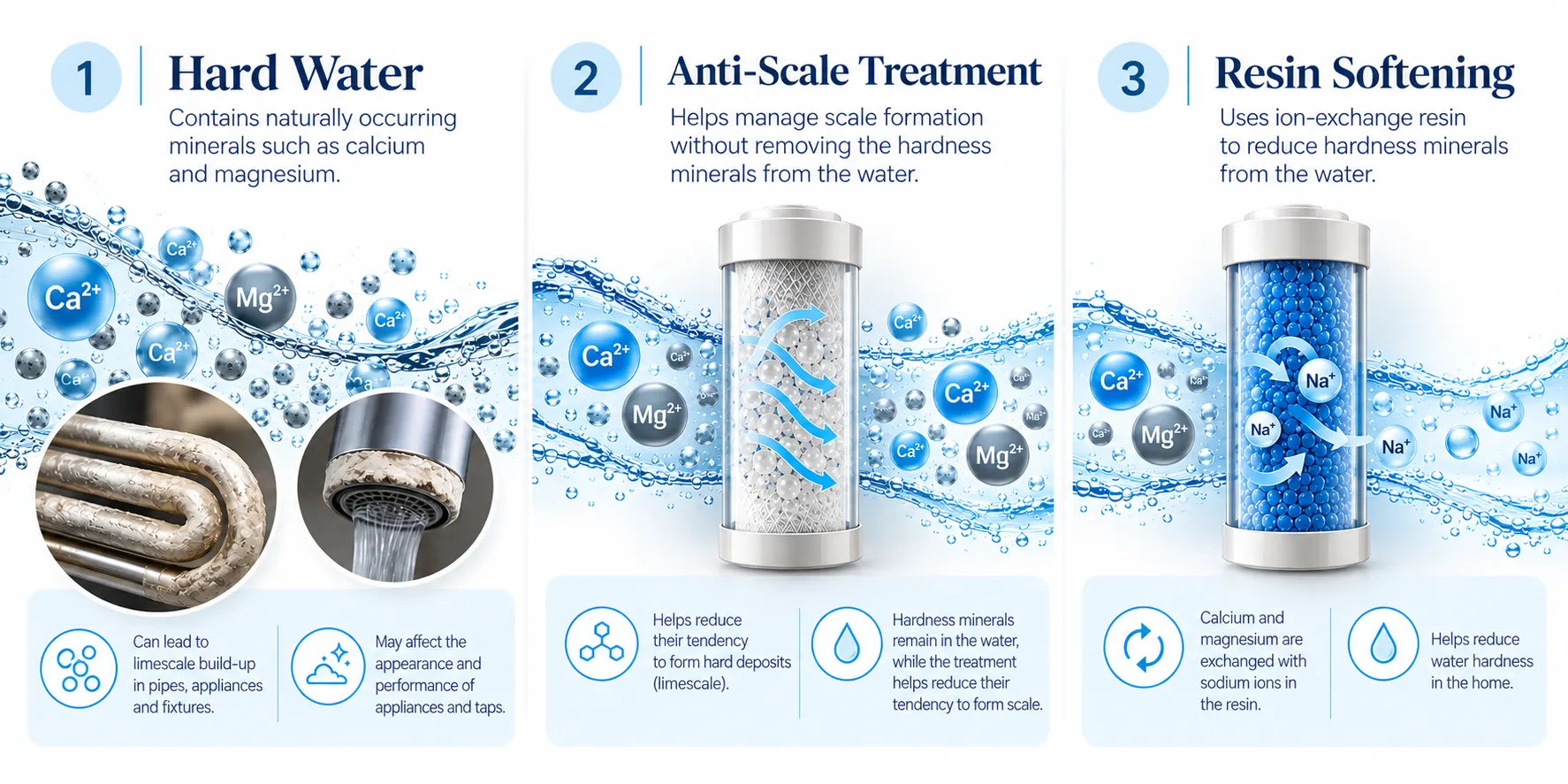
Water hardness is primarily a measure of dissolved calcium and magnesium. These minerals occur naturally as water moves through soil and rock. Water Corporation notes that some WA groundwater-supplied areas experience harder water.
Hardness is usually expressed as milligrams per litre as calcium carbonate (mg/L as CaCO3). It is mainly an aesthetic and operational characteristic rather than a reason to describe drinking water as unsafe.
What you may notice
Harder water can leave mineral spotting on glass, shower screens or fixtures after water evaporates. It can also affect soap behaviour and contribute to scale in heated equipment.
Hardness is not uniform across Perth or the South West. A single statement such as ‘Perth has hard water’ is too broad because supply sources and local chemistry vary.
Why ordinary particulate filtration does not remove hardness
Dissolved calcium and magnesium ions are not sediment. Water Corporation explicitly notes that these minerals cannot be removed by ordinary filtration simply because they are dissolved in the water.
That is why a sediment/carbon whole-home filter should not be advertised as a true water softener.
Anti-scale versus ion-exchange softening
An anti-scale stage is intended to manage scale-related behaviour; it does not remove hardness minerals in the same way as ion-exchange softening.
A conventional ion-exchange softener exchanges hardness ions such as calcium and magnesium for other ions, reducing measured hardness. If actual hardness removal is the objective, a softener is the relevant technology.
If you are looking for a softener, tell Purenest Australia during the assessment so the recommendation can be built around that goal.
Local examples
Aqwest says Bunbury water is around 100 mg/L as CaCO3, placing it around the moderately soft to slightly hard range in its classification table. Busselton Water’s July-September 2025 distribution samples reported hardness around 100 mg/L as CaCO3. Water Corporation’s 2023-24 Dunsborough aesthetic data reported hardness values in the approximate range 67-78 mg/L as CaCO3 for the sampled points.
These figures are local snapshots, not a substitute for current property-specific information.
Sources and last reviewed
Last reviewed: September 2026.
- Water Corporation — Hard water
- Aqwest — FAQs / hardness
- Busselton Water — Water quality reports
- Water Corporation — South West aesthetic data
This article is general educational information and does not replace water testing, utility advice, plumbing advice or health advice for a specific circumstance.