
How RO works
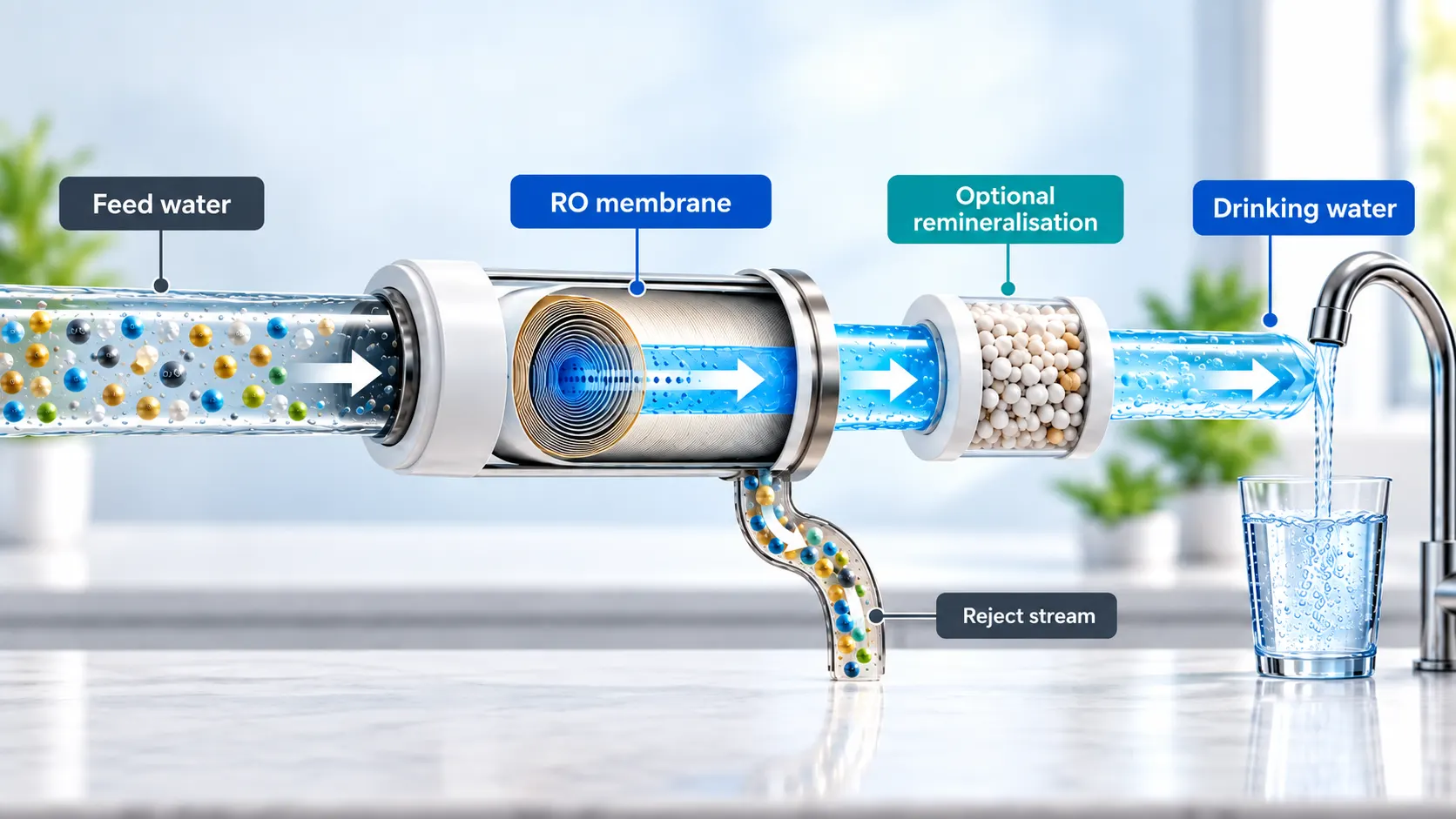
Reverse osmosis uses pressure to move water through a semi-permeable membrane. The membrane allows water through while rejecting a high proportion of many dissolved ions and other substances, depending on membrane design and operating conditions.
Large-scale seawater desalination plants use reverse-osmosis membranes, although residential point-of-use systems operate at a much smaller scale.
Where residential RO fits
Residential RO is commonly used at point of use for drinking and cooking water. It can be useful when the desired treatment involves dissolved salts or other substances that are not removed simply by sediment or carbon filtration.
Practical considerations
- Membrane performance depends on feed-water quality, pressure and maintenance.
- RO systems usually produce a concentrate/reject stream as part of separation.
- Pre-filtration helps protect the membrane.
- Post-treatment or remineralisation may be used depending on product design and preference.
Choosing the right technology
If the goal is filtered water throughout the home for sediment/chlorine-related preferences, whole-home treatment may be appropriate. If the goal is more intensive point-of-use treatment for drinking water, RO may be the better fit. Some homes use whole-home filtration upstream and RO at the kitchen.
Sources and last reviewed
Last reviewed: September 2026.
- Water Corporation — Perth’s water supply (desalination / reverse osmosis context)
- NHMRC — Australian Drinking Water Guidelines
This article is general educational information and does not replace water testing, utility advice, plumbing advice or health advice for a specific circumstance.